← Research

Designing Smart School Choice Recommendations: Heuristics for Sure Alternatives

Ignacio Lepe · Master’s thesis, Universidad de Chile, 2025 · Advisor: Dante Contreras

Abstract

I propose a school choice policy to recommend guaranteed school alternatives for students left unassigned under stable matching. By leveraging revealed preferences, I design a personalized recommendation mechanism that offers voluntary allocations to unlisted but potentially desirable nearby schools. Using rich administrative data from the Chilean school choice system, I simulate the proposed intervention across the full applicant pool to assess its general equilibrium effects on the resulting allocations. Results indicate that in the main round, the mechanism is able to (i) reduce the proportion of unmatched applicants by up to 50%, (ii) increase expected aggregate utility by 2–6%, and (iii) concentrate utility gains among applicants who apply to oversubscribed programs. To facilitate implementation, I develop a targeted submarket implementation that yields comparable improvements while preserving all original assignments. Overall, the policy offers a cost-effective and scalable solution to improve match outcomes by redistributing excess demand within centralized assignment systems.

Insights
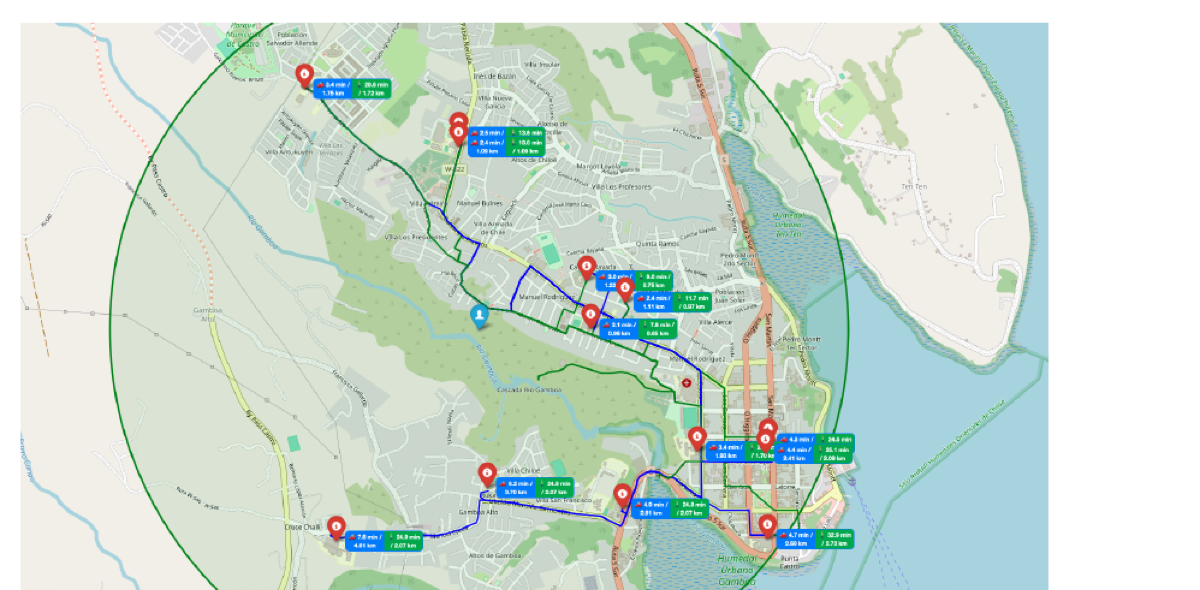
Route map for a student in Chiloé, Chile, showing walking and driving times to nearby schools within a radius.
First, know each family's real options. Before recommending anything, the tool maps every applicant's actual neighborhood of schools. For this student in Chiloé, it computes real walking and driving times to each nearby school (the bubbles), so a recommended option is one that is genuinely reachable, not just close in a straight line.
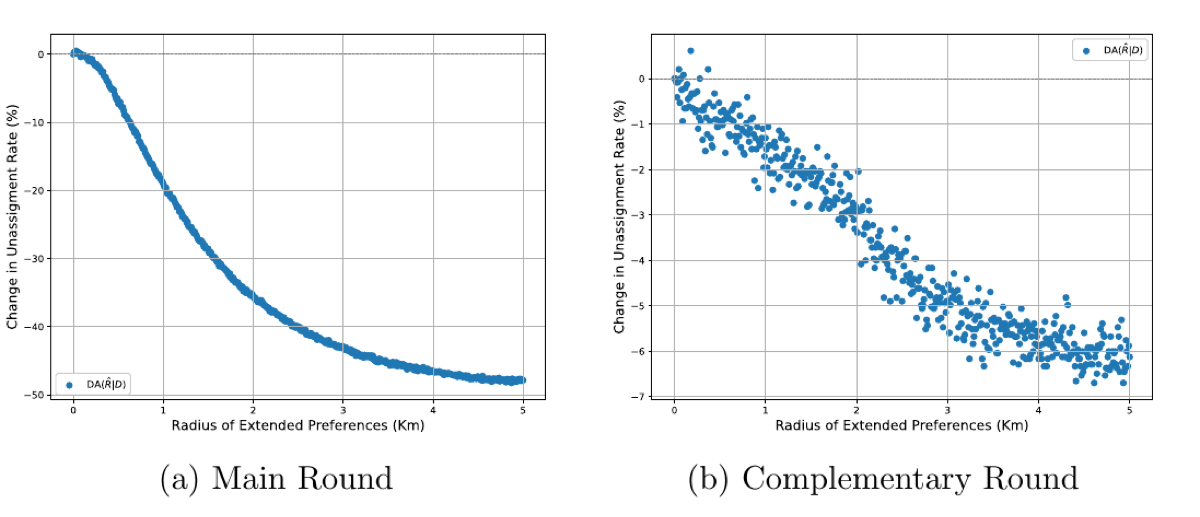
Two panels showing the percentage change in the unassignment rate falling as the radius of recommended nearby schools grows, by up to about 50 percent in the main round.
Then, close the gap. As the tool widens the radius of nearby schools it suggests, the share of students left with no assignment falls steadily, by up to about 50% in the main round (left panel). Simply surfacing reachable schools that families did not think to list keeps far more students from going unmatched.
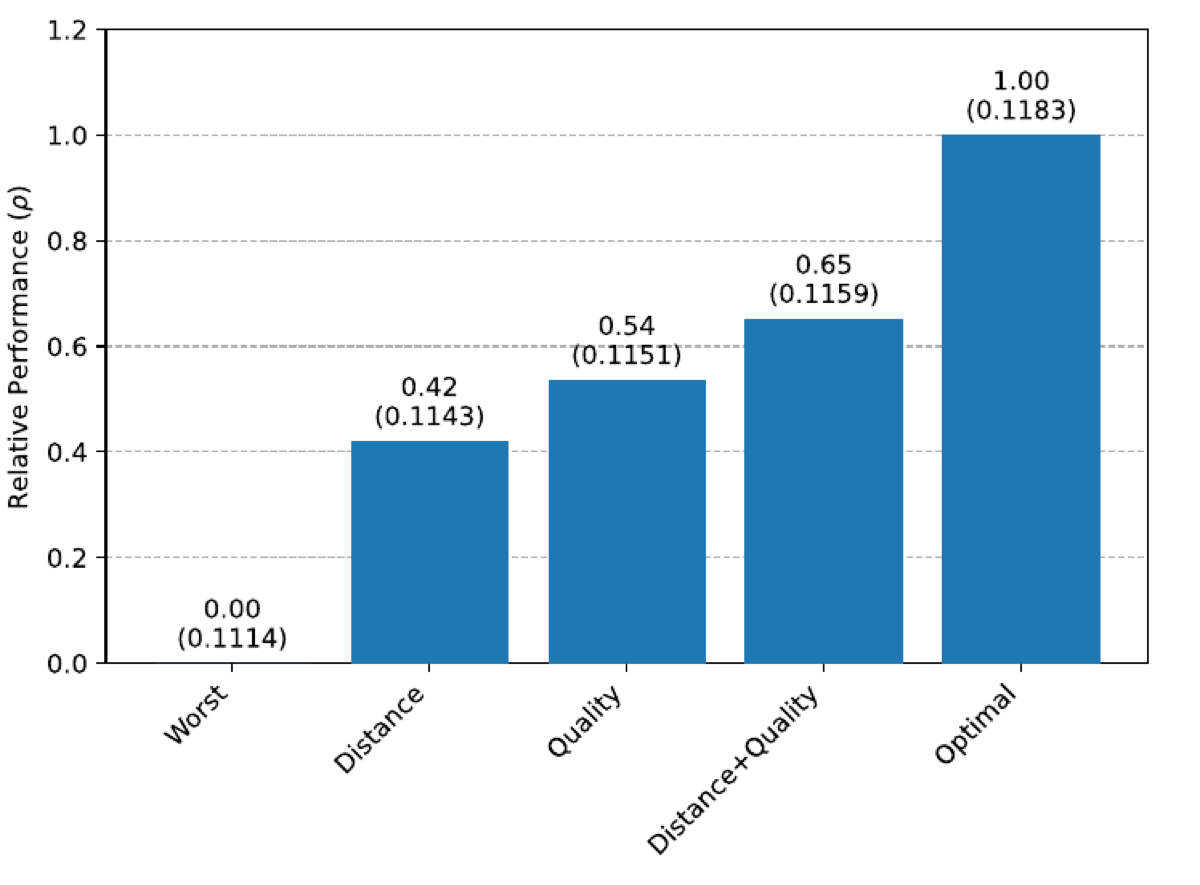
Bar chart comparing the relative performance of recommendation ordering policies: worst 0.00, distance 0.42, quality 0.54, distance plus quality 0.65, optimal 1.00.
And keep it simple. You do not need a black-box algorithm to capture most of the benefit. Ordering the suggested schools by distance alone recovers about 42% of the ideal welfare gain; adding school quality lifts that to 65%, closing much of the distance to the optimal ranking. Transparent rules a family can actually understand deliver most of what a fully optimized system would.

Citation

Lepe, I. (2025). Designing smart school choice recommendations: Heuristics for sure alternatives [Master’s thesis, Universidad de Chile]. Repositorio Académico de la Universidad de Chile. https://repositorio.uchile.cl/handle/2250/208139
@mastersthesis{lepe2025designing,
  author = {Lepe, Ignacio},
  title  = {Designing Smart School Choice Recommendations: Heuristics for Sure Alternatives},
  school = {Universidad de Chile},
  year   = {2025}
}

Links

Thesis (Repositorio Académico, Universidad de Chile)

JEL: C78, D47, I21, I28, D83  ·  Keywords: school choice, market design, sure alternative